

Choosing The Right Flooring For Your Home
Article published by Homestars, Jan 5, 2026
Besides the traditional carpet mainstay, some of today’s most innovative choices for flooring include porcelain tile, natural stone and luxury vinyl planks. Let's look at pros and cons of each.
New flooring can dramatically change the look and feel of any room. If you are renovating a space, one of the first things you should consider before you do anything to the room is replace the flooring. This is especially true when you’re dealing with old and worn out carpets, outdated laminate flooring, or tattered linoleum.
Today’s homeowner can make decisions on their flooring based on needs such as cleanliness, environmentally friendly products, durability and room usage.
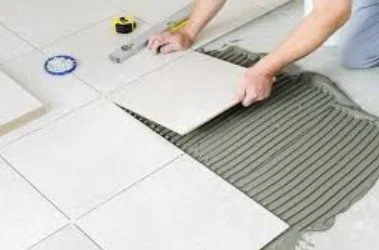
Shows a professional tiler installing porcelain tile
Hardwood
Milled from solid lumber – a natural insulator – hardwood adds structural strength to the home. Hardwood is easy to clean, durable, and looks beautiful with any decor. Hardwood floors tend to attract less dust and trap less dirt than carpeting. They do not attract allergens or molds that cause allergies, which tend to travel with dust, which makes them a better choice for individuals with allergies or asthma.
Depending on hardwood species, dimensions and width, the cost of hardwood can be on par with engineered hardwood, but it’s not moisture resistant, so any spills must be promptly cleaned up. Also be aware that because hardwood floors are essentially solid wood cut to 3/4″ thickness, individual boards can shrink and expand depending on the humidity in your home. In order to avoid seasonal gapping from becoming noticeable and to reduce the amount of movement, relative indoor humidity level should be kept at 45-55% throughout the year.
Your new floors must therefore be installed to leave the right amount of space for natural expansion and contraction. If the individual boards are fitted too tight your floor will buckle. If they’re too loose the gaps between the boards will get too wide in the winter. Keeping humidity consistent is also key.
Hardwood is more challenging to install in a condominium than in a house. This is due to the fact that hardwood boards must be nailed into the floor and condominiums are almost exclusively built with concrete. A moisture barrier as well as an underlayment moisture barrier must be used. It’s important to be aware of noise transfer requirements in accordance with your condo association rules. Your condo board will ask for the IIC sound rating of the underlayment.
Engineered Hardwood
Engineered hardwood is a top layer of actual dried out hardwood with lower layers consisting of either of several layers of plywood, HDF (high-density fibreboard), or solid wood bonded together under pressure. To most homeowners, there is very little visual difference between engineered hardwood and hardwood. It is durable and more moisture resistant than hardwood, making it suitable for interiors where fluctuations in humidity and temperature may be significant such as cottages and basements.
Compared to hardwood, there are more methods of installing engineered hardwood, which means that it is a more flexible product. It can, however, be more expensive than hardwood, depending on the plank size, cost of lumber, and cost and quality of glues used for adhering layers.
Concrete
Concrete is a stylish choice for homeowners that wish to live with an industrial type of decor choice for their floors. Concrete has some real benefits as it is difficult to damage. High heels, furniture legs, and pet claws will not scratch the surface, and water does not easily damage a concrete floor.
A concrete floor is very easy to take care of. Mop the floor periodically and seal or wax every 3-9 months depending on the level of traffic in the room. A sealed and properly maintained concrete floor can last indefinitely. Some homeowners find concrete floors cold, but this can be circumvented by the addition of radiant heating under the floor surface.
Stone Tile Flooring
Beautiful and organic in nature, stone tiles are quarried from mountain materials and include: slate, marble, travertine and granite. Each of these types of stone has slightly different properties. It’s important to understand the characteristics of each type of stone flooring to determine whether it is appropriate for a specific location. Stone tile can be used inside and outside the home, depending on how porous the stone is.
For high-traffic areas in your home, or patio areas outside, look for vitreous or impervious stone. Additionally many stone floors are graded for quality. Grade 1 refers to high quality, uniform materials. Grade 2 consists of materials with minor defects such as chips, scratches, or irregular surfaces. Grade 3 materials have major flaws in size, shape, surface, or chipping, making them appropriate only as accent or decorative pieces.
Porcelain (Ceramic) Tile
Porcelain tile has been used by humans to covers floors since ancient times. It’s made of clay which is then fired and glazed to protect the surface from moisture and damage. It’s perfect for kitchens, bathrooms and high-traffic areas such as entryways as it’s totally water resistant, easy to clean and does not harbour germs. And it’s a great choice for those who suffer from asthma, as dust and debris are easy to see and clean up.
The cost of quality tile can range from $ - $$$$. An installation by a skilled tradesperson can last between 10 to 20 years.
Depending on your needs, any of these innovative ideas can create beautiful looks in your home.
Original article: Choosing the right flooring for your needs
When you’re ready to redo your flooring and need guidance, schedule a call with Barbara Nyke for a Design Discovery Call.
I post this Toronto interior design blog as regularly as possible. Stay tuned for more informative & inspiring design blog posts.
